|
|
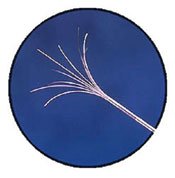
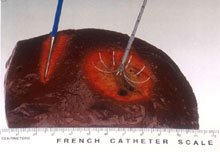
Radiofrequency Ablation (RFA)Radiofrequency ablation, also known as RFA, is an exciting, recently developed technique used to treat malignant liver tumors. Radiofrequency ablation uses electrical current, passed through a multiple small needles placed directly into a liver tumor, to destroy cancer cells with heat. The electrical current is actually passed across an array of hook electrodes that are deployed from the tip of the needle after the needle is placed into the tumor. The hook electrodes look like the ribs of an umbrella, with a diameter of 3.5 cm (slightly greater than an inch) when fully deployed. An ultrasound probe is used to guide the placement of the needle into the tumors to be treated, and after the needle is in the correct area, the hook electrodes are deployed into the liver tumor. The treatment is started by applying electrical current from a radiofrequency current generator. The amount of power supplied by the generator can be controlled precisely, and the generator is also used to monitor the treatment until complete heat-induced destruction of the tumor being treated occurs.
| RFA Probes |
 |
 |
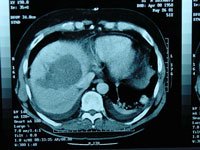
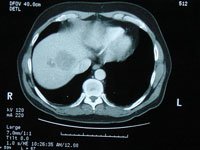
| Pre-RFA |
Post-RFA |
 |
 |
Radiofrequency ablation can be performed during an abdominal operation, using laparoscopic surgical guidance (so-called minimally invasive surgery), or by placing the needle through the skin directly into the tumor. The surgeons in the University of Louisville Division of Surgical Oncology can explain the different approaches to each patient. In addition some patients are best treated by combining the removal of the largest liver tumors with RFA of any smaller tumors during the same open operation. It is important to note that RFA performed laparoscopically or through the skin still requires anesthesia so the patient will feel no pain or discomfort during the treatment.
RFA is a relatively new, but very exciting treatment for patients with some types of malignant liver tumors. The treatments have been safe and well tolerated in the overwhelming majority of patients. RFA has opened more options to patients who previously would not have been considered for aggressive surgical treatments because of the number of tumors, location of tumors too near major blood vessels, problems with cirrhosis, or inability to remove the entire tumor while leaving behind enough normal liver. The University of Louisville, Division of Surgical Oncology-- who continues to develop improved equipment to treat larger tumors--uses RFA, often in combination with other types of treatments, in hopes of eradicating all the patients malignant cells.
If you believe that you are a candidate for RFA, click here
|
|